Menu
Close
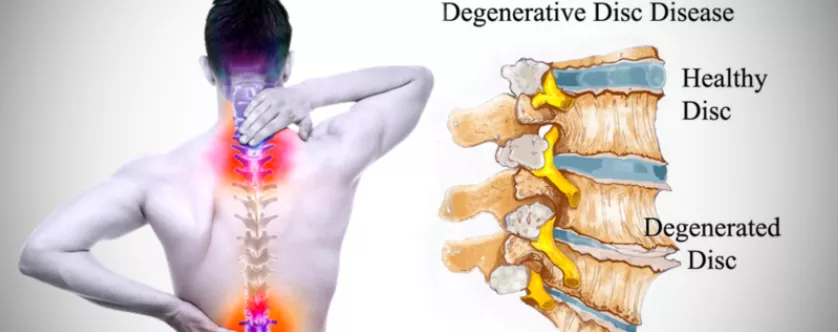
Degenerative spine disease is a common term for the slow wear and tear of the spine that happens with age. Over the years, the discs between the spine bones lose water and height, the small joints at the back of the spine develop arthritis, bone spurs form and the ligaments become thick. These changes can happen in the neck, mid back or lower back, and they often affect more than one level of the spine. Almost everyone shows some signs of spine degeneration on scans after the age of 40, but not everyone has pain.
When degeneration starts pressing on the nerves or makes the spine unstable, it can cause back pain, neck pain, leg or arm pain, numbness and difficulty in walking. It includes conditions like disc degeneration, spondylosis, facet joint arthritis, spinal stenosis and spondylolisthesis. At SpineArc, Dr. Tanmay Avhad has special interest in complex and multilevel degenerative spine conditions. His research on multilevel endoscopic decompression, based on a study of 120 patients, won 3rd place for Best Paper at SMISS 2026 in Singapore. He focuses on finding which level is actually causing the pain and treating it with the least invasive option that works.
The symptoms of degenerative spine disease depend on which part of the spine is affected. Common symptoms include:


Degenerative spine disease is mainly caused by age related changes, but some factors can speed it up. Common causes include:
To treat degenerative spine disease the right way, the exact level and cause of symptoms must be found first. At SpineArc, diagnosis and treatment follow a step by step approach:
Some people are more likely to have painful spine degeneration. Knowing these factors can help you take early care:
Spine degeneration increases steadily after the age of 40.
Some people inherit a tendency for early disc and joint wear.
Years of lifting, bending and twisting speed up spine wear.
More weight adds load on the discs and joints.
Smoking weakens the discs, and weak muscles give less support to the spine.
Get the right diagnosis and advanced degenerative spine treatment in Mumbai from Dr. Tanmay Avhad at 4 hospitals across the city. Available 6 days a week, book your consultation today.
Everything you need to know about degenerative spine disease treatment in Mumbai, answered simply by Dr. Tanmay Avhad.
It is the age related wear and tear of the spine discs, joints and ligaments. It can cause back or neck pain, nerve pressure and stiffness.
Some spine wear is a normal part of ageing and may not cause any problem. It becomes a disease when it causes pain, nerve pressure or instability that affects daily life.
Yes. Most patients do well with medicines, physiotherapy, lifestyle changes and image-guided injections. Surgery is needed only when nerve pressure or instability does not improve.
Yes. In suitable patients, multilevel endoscopic decompression can treat nerve pressure at more than one level through small cuts, with less muscle damage and faster recovery.
No. Many MRI findings are not the real cause of pain. The goal is to find the exact level causing your symptoms and treat only that, which avoids unnecessary surgery.
You can call +91 79779 26003 or +91 99203 97922, send a WhatsApp message, or fill the form on this website. Our team will call you to confirm your time and hospital.
Dr. Tanmay consults at 6 hospitals in Mumbai:
SpineArc is the spine practice of
Dr. Tanmay Avhad, a Gold Medalist Orthopaedic Spine Surgeon in Mumbai. The practice focuses on advanced, precise and minimally invasive spine care, from image-guided pain procedures to uniportal full endoscopic spine surgery, with the right treatment chosen for every patient.
Designed & Developed by DigiScrub
© SpineArc 2026 | All Rights Reserved