Menu
Close
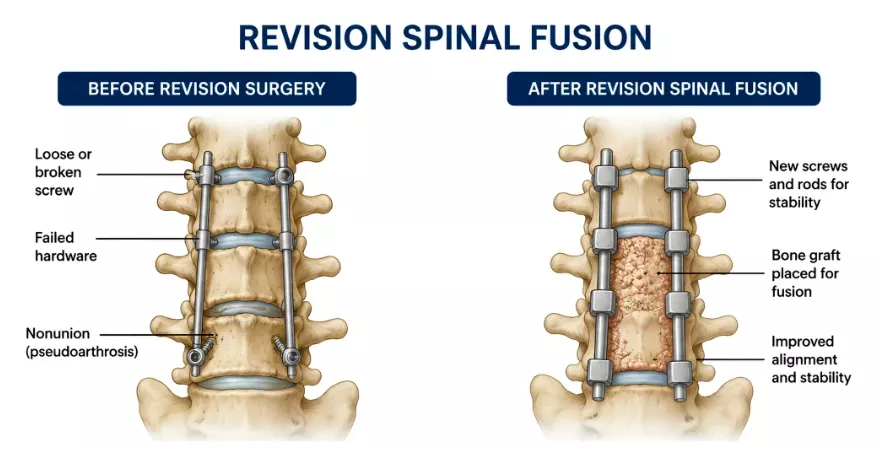
Spine surgery helps most patients get relief from pain, but in some people the pain does not go away fully, or it comes back after months or years. This can happen due to a repeat slipped disc at the same level, new problems at nearby levels, scar tissue around the nerves, loosening of screws, or the fusion not healing properly. Studies show that about 5 to 15 percent of patients may have a repeat disc slip after disc surgery. When pain continues or returns after spine surgery, it is often called failed back surgery syndrome, and it may need a second surgery known as revision spine surgery.
Revision spine surgery is more difficult than the first surgery because of scar tissue, changed anatomy and implants from the earlier operation. Many patients are also worried about going through another big surgery. At SpineArc, Dr. Tanmay Avhad has a special interest in endoscopic revision spine surgery. Using endoscopic techniques, he can often reach the problem through a fresh path that avoids the old scar, through a small cut, with less risk to the nerves and a faster recovery. His focus is first on finding exactly why the pain has returned, because the right diagnosis is the key to success in revision cases.
The symptoms after spine surgery depend on the cause of the problem. Common symptoms include:


Pain after spine surgery can happen for many reasons. Some of the most common causes are:
To treat pain after spine surgery the right way, the exact reason for the problem must be found first. At SpineArc, diagnosis and treatment follow a step by step approach:
Some people are more likely to need revision spine surgery. Knowing these factors can help you take early care:
Smoking slows healing and increases the risk of failed fusion and repeat disc problems.
These increase the risk of infection and put extra load on the spine.
Returning to heavy work too soon after surgery can cause the disc to slip again.
Osteoporosis can lead to screw loosening after fusion.
If the real pain source was not treated, pain may continue after surgery.
Get the right diagnosis and advanced revision spine surgery in Mumbai from Dr. Tanmay Avhad at 4 hospitals across the city. Available 6 days a week, book your consultation today.
Everything you need to know about recurrent and revision back surgery in Mumbai, answered simply by Dr. Tanmay Avhad.
Pain can return due to a repeat disc slip, wear and tear at nearby levels, scar tissue, loose implants, a failed fusion or a pain source that was not treated earlier. A detailed check is needed to find the exact reason.
It is a term used when back or leg pain continues or returns after spine surgery. It is not a single disease, and the treatment depends on the actual cause.
No. Many patients improve with medicines, physiotherapy and image-guided injections. Revision surgery is advised only when there is a clear cause like nerve pressure, instability or implant failure.
Yes. In many cases, endoscopic revision surgery can reach the problem through a fresh path that avoids the old scar, through a small cut, with less nerve risk and faster recovery.
Bring all your earlier surgery notes, discharge summary, old and new MRI or CT scans, X-rays and a list of your current medicines. This helps plan the right treatment.
You can call +91 79779 26003 or +91 99203 97922, send a WhatsApp message, or fill the form on this website. Our team will call you to confirm your time and hospital.
Dr. Tanmay consults at 6 hospitals in Mumbai:
SpineArc is the spine practice of
Dr. Tanmay Avhad, a Gold Medalist Orthopaedic Spine Surgeon in Mumbai. The practice focuses on advanced, precise and minimally invasive spine care, from image-guided pain procedures to uniportal full endoscopic spine surgery, with the right treatment chosen for every patient.
Designed & Developed by DigiScrub
© SpineArc 2026 | All Rights Reserved