
Menu
Close
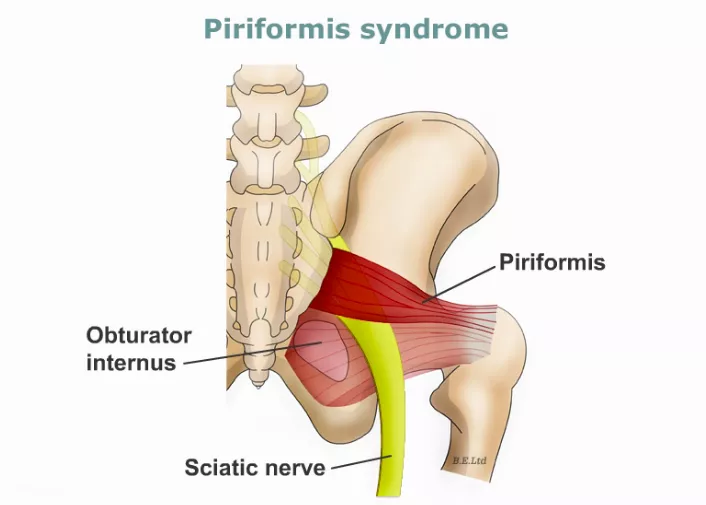
The piriformis is a small muscle deep in the buttock that helps rotate the hip and keep the pelvis stable. The sciatic nerve, the largest nerve in the body, runs right under or sometimes through this muscle. When the piriformis muscle becomes tight, swollen or goes into spasm, it can press on the sciatic nerve and cause pain in the buttock and leg. This condition is called piriformis syndrome.
Piriformis syndrome often feels just like sciatica from a slipped disc, which is why it is commonly missed or treated as a back problem. It is more common in people who sit for long hours, runners, cyclists and those who have had a fall on the buttock. In Mumbai, long office hours and long commutes sitting in cars and trains are common triggers. At SpineArc, Dr. Tanmay Avhad first checks whether the leg pain is coming from the spine or from the piriformis muscle, and then treats it with the right plan, including image-guided piriformis injections when needed.
Piriformis syndrome usually affects one side of the body. Common symptoms include:


Piriformis syndrome happens when the piriformis muscle irritates or presses on the sciatic nerve. Some of the most common causes are:
To treat piriformis syndrome the right way, spine causes of leg pain must first be ruled out. At SpineArc, diagnosis and treatment follow a step by step approach:
Some people are more likely to get piriformis syndrome. Knowing these factors can help you take early care:
Desk jobs, long driving and long commutes put steady pressure on the muscle.
Running, cycling and heavy leg workouts can overwork the muscle.
A fall on the buttock can cause swelling and scarring around the muscle.
Weak hip muscles or tight hamstrings add strain to the piriformis.
Leg length difference or foot problems put more load on one side.
Get the right diagnosis and advanced piriformis syndrome treatment in Mumbai from Dr. Tanmay Avhad at 4 hospitals across the city. Available 6 days a week, book your consultation today.
Everything you need to know about piriformis syndrome treatment in Mumbai, answered simply by Dr. Tanmay Avhad.
It is a condition where the piriformis muscle in the buttock becomes tight or goes into spasm and presses on the sciatic nerve, causing pain in the buttock and leg.
Both can cause similar leg pain. In piriformis syndrome, the nerve is pressed in the buttock, while in a slipped disc it is pressed in the spine. An examination and MRI help find the difference.
Yes. Almost all patients improve with stretching, physiotherapy, medicines and image-guided piriformis injections. Surgery is very rarely needed.
It is an injection given into the piriformis muscle under image guidance. It reduces muscle spasm and nerve irritation, and also helps confirm the diagnosis.
Yes. Sitting for long hours, especially on hard seats or with a wallet in the back pocket, puts pressure on the muscle and nerve and can trigger pain.
You can call +91 79779 26003 or +91 99203 97922, send a WhatsApp message, or fill the form on this website. Our team will call you to confirm your time and hospital.
Dr. Tanmay consults at 6 hospitals in Mumbai:
SpineArc is the spine practice of
Dr. Tanmay Avhad, a Gold Medalist Orthopaedic Spine Surgeon in Mumbai. The practice focuses on advanced, precise and minimally invasive spine care, from image-guided pain procedures to uniportal full endoscopic spine surgery, with the right treatment chosen for every patient.
Designed & Developed by DigiScrub
© SpineArc 2026 | All Rights Reserved