Menu
Close
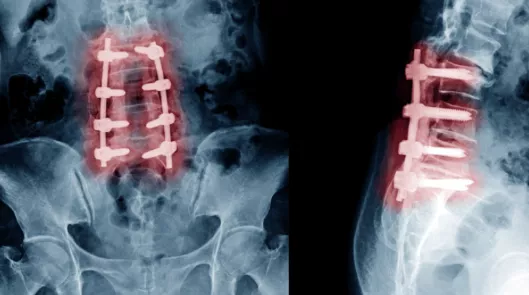
Decompression surgery means removing whatever is pressing on the spinal cord or nerves, like a slipped disc, bone spurs or thickened ligament, so that the nerves get space and the pain, numbness or weakness can settle. In the past, many decompression surgeries removed a large amount of bone and joints, which could make the spine unstable and often led to a fusion, where two or more spine bones are joined together permanently. Fusion stops movement at that level and can put extra load on the levels above and below.
Motion preservation is a modern approach where the surgeon frees the nerves while keeping the spine’s natural joints, ligaments and movement as intact as possible, so that fusion can be avoided whenever it is safe. It is one of the three core pillars of SpineArc, along with surgical precision and minimal tissue trauma. Dr. Tanmay Avhad uses endoscopic and minimally invasive techniques to achieve targeted decompression with minimal bone removal. His research on interlaminar endoscopic contralateral decompression, published in the Asian Spine Journal, focuses on freeing nerves on both sides through a single small approach while preserving the normal structures of the spine.

Motion preserving decompression is performed for patients whose nerves or spinal cord are pressed, causing back pain, leg or arm pain, numbness, weakness or difficulty in walking, and who do not improve with medicines, physiotherapy and injections. It is commonly used for lumbar spinal stenosis, foraminal stenosis, slipped disc with nerve compression, lateral recess stenosis, cervical radiculopathy and some cases of cervical myelopathy. The aim is to relieve nerve pressure fully while keeping the spine stable and mobile, so the patient avoids an unnecessary fusion. This helps maintain natural spine movement, lowers the stress on nearby levels, and usually allows a faster recovery with less pain.
The procedure is usually done through a single small cut using an endoscope or a tubular retractor with high magnification, under local or general anaesthesia based on the case. Using a C-arm (live X-ray machine), the surgeon reaches the exact level of nerve pressure. Instead of removing large parts of the spine bone and joints, only the specific bone spur, thick ligament or disc fragment pressing on the nerve is carefully removed. In spinal stenosis, the surgeon can enter from one side and clean both sides of the spinal canal through the same small opening, which protects the muscles and the joints on the other side. In the neck, nerve pressure can be relieved through a small opening at the back of the spine (foraminotomy), avoiding fusion in suitable patients. High definition endoscopic vision, fine instruments and real time neuromonitoring help protect the nerves and keep the facet joints and supporting ligaments intact.
Because the muscles, joints and ligaments are largely preserved, recovery after motion preserving decompression is usually quick. Most patients walk within a few hours of surgery and go home within 24 to 36 hours. Leg or arm pain often improves soon after the procedure, while numbness and weakness may take a few weeks to months to recover, depending on how long the nerve was pressed. Light daily activities and desk work can usually be resumed in 1 to 2 weeks, and heavier activities are increased gradually over 4 to 8 weeks with physiotherapy. Since there is no fusion, the spine keeps its natural movement and there is no need to wait for bones to join.
Get advanced motion preserving spine decompression in Mumbai from Dr. Tanmay Avhad at 4 hospitals across the city. Available 6 days a week, book your consultation today.
Everything you need to know about motion preservation and decompression surgery in Mumbai, answered simply by Dr. Tanmay Avhad.
It is a surgery to remove the disc, bone spur or thick ligament that is pressing on the spinal cord or nerves, so the nerves get space and symptoms can improve.
It means treating the spine problem while keeping the natural joints and movement of the spine, so that fusion can be avoided whenever it is safe.
Many patients with spinal stenosis or slipped disc can be treated with decompression alone, without fusion. Fusion is needed only when the spine is unstable, like in some cases of spondylolisthesis.
Fusion stops movement at the joined levels and can increase stress on nearby levels over time. Keeping natural movement helps the spine work more normally and usually means faster recovery.
Yes. With endoscopic techniques, the surgeon can enter from one side and free the nerves on both sides of the spinal canal, while protecting the muscles and joints.
You can call +91 79779 26003 or +91 99203 97922, send a WhatsApp message, or fill the form on this website. Our team will call you to confirm your time and hospital.
Dr. Tanmay consults at 6 hospitals in Mumbai:
SpineArc is the spine practice of
Dr. Tanmay Avhad, a Gold Medalist Orthopaedic Spine Surgeon in Mumbai. The practice focuses on advanced, precise and minimally invasive spine care, from image-guided pain procedures to uniportal full endoscopic spine surgery, with the right treatment chosen for every patient.
Designed & Developed by DigiScrub
© SpineArc 2026 | All Rights Reserved