
Menu
Close
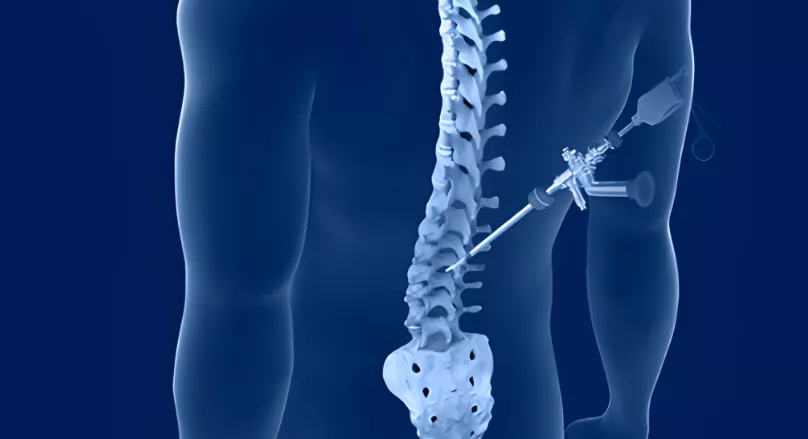
Minimally invasive spine surgery, or MISS, is a modern way of doing spine surgery through small cuts instead of one long cut. In traditional open surgery, the back muscles are cut and pulled apart to reach the spine. In MISS, the surgeon uses special tubes, fine instruments, magnification and live X-ray guidance to reach the spine between the muscles, without stripping them off the bone. This means less damage to healthy tissue, less blood loss, less pain after surgery and a faster return to daily life.
MISS is a broad term that includes many procedures, like minimally invasive decompression, minimally invasive fusion and percutaneous screw fixation. Endoscopic spine surgery is the most advanced form of MISS. At SpineArc, Dr. Tanmay Avhad, who holds a Fellowship in Minimally Invasive Spine Surgery (FMISS), chooses the least invasive method that can safely and fully treat each patient’s problem. His focus is on precision, preserving normal anatomy and helping patients return to an active life as early as possible.

Minimally invasive spine surgery is performed for spine problems that do not improve with medicines, physiotherapy and injections, or when there is nerve weakness, instability or a fracture. It is used for slipped disc, spinal stenosis, spondylolisthesis, spine instability, degenerative disc disease, spine fractures, and to stabilise the spine in cases of infection or tumour. MISS aims to relieve nerve pressure, stabilise the spine where needed and reduce pain, while avoiding the large cuts, muscle damage and longer recovery of open surgery. It is especially helpful for elderly patients, those with other health problems, and patients who need to return to work quickly.
MISS is usually done under general anaesthesia, and in some cases under spinal or local anaesthesia. Using a C-arm (live X-ray machine) and navigation, the surgeon marks the exact level and makes one or more small cuts, usually 1 to 3 cm long. Special tubular retractors are passed through the muscles to create a small working channel to the spine, and the surgery is done under high magnification. Through this channel, the surgeon can remove a slipped disc, bone spurs or thick ligament pressing on the nerves. When the spine needs to be stabilised, like in spondylolisthesis or fractures, screws and rods are placed through small skin cuts (percutaneous screw fixation), and a bone graft or cage is placed between the spine bones to help them fuse. This is done in procedures like MIS TLIF. Intraoperative neuromonitoring is used to protect the nerves, and the small cuts are closed with a few stitches.
Recovery after minimally invasive spine surgery is faster than after open surgery. After a minimally invasive decompression, most patients walk the same or next day and go home within 1 to 2 days. After a minimally invasive fusion or fixation, patients usually walk with support within a day and go home in about 2 to 4 days. Desk work can often be resumed in 2 to 4 weeks, while heavy lifting, driving long distances and sports are resumed gradually over 6 to 12 weeks, especially after fusion, as the bones need time to join. A guided physiotherapy program helps build strength and supports a smooth recovery.
Get advanced minimally invasive spine surgery in Mumbai from Dr. Tanmay Avhad at 4 hospitals across the city. Available 6 days a week, book your consultation today.
Everything you need to know about minimally invasive spine surgery in Mumbai, answered simply by Dr. Tanmay Avhad.
It is spine surgery done through small cuts using special tubes, magnification and X-ray guidance, so the muscles are not cut open like in traditional surgery.
MISS is a broad group of small cut surgeries. Endoscopic spine surgery is the most advanced type of MISS, done through a single 8mm cut using a camera. The right option depends on your spine problem.
Yes, when done by a trained spine surgeon in the right patient. It usually has less blood loss, lower infection risk and less pain after surgery than open surgery.
Yes. Procedures like MIS TLIF and percutaneous screw fixation allow fusion and stabilisation through small cuts, with faster recovery than open fusion.
Most patients are, but some complex cases, like large deformities or certain revision surgeries, may still need open surgery. Dr. Tanmay will suggest the safest option after a detailed check.
You can call +91 79779 26003 or +91 99203 97922, send a WhatsApp message, or fill the form on this website. Our team will call you to confirm your time and hospital.
Dr. Tanmay consults at 6 hospitals in Mumbai:
SpineArc is the spine practice of
Dr. Tanmay Avhad, a Gold Medalist Orthopaedic Spine Surgeon in Mumbai. The practice focuses on advanced, precise and minimally invasive spine care, from image-guided pain procedures to uniportal full endoscopic spine surgery, with the right treatment chosen for every patient.
Designed & Developed by DigiScrub
© SpineArc 2026 | All Rights Reserved