
Menu
Close
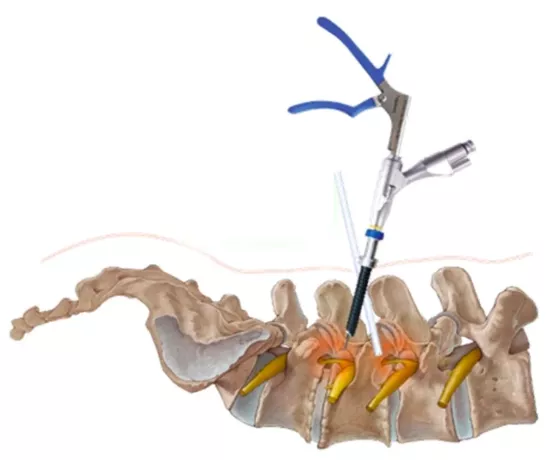
Spinal fusion is a surgery that joins two or more spine bones together so they heal into one solid bone. It is done when a part of the spine has become unstable or has slipped, causing back pain and nerve pressure. In traditional open fusion, a long cut is made and the back muscles are stripped away from the spine to place screws, rods and a cage, which leads to more pain, more blood loss and a longer recovery. Endoscopic fusion surgery is one of the most advanced ways to do the same fusion through a few small cuts, using an endoscope and image guidance.
In endoscopic fusion, the nerves are freed, the damaged disc is cleaned and a cage is placed between the spine bones under direct camera vision, while screws are placed through small skin cuts without opening the muscles. At SpineArc, Dr. Tanmay Avhad performs endoscopic and minimally invasive fusion procedures like Endo TLIF, Endo LIF and K-LIF, along with MIS TLIF and percutaneous screw fixation. He has trained in these techniques through his fellowship and specialised workshops, and uses them only when fusion is truly needed, choosing decompression alone whenever the spine is stable.

Endoscopic fusion surgery is performed when the spine is unstable or when the problem cannot be fixed with decompression alone. It is commonly used for degenerative and isthmic spondylolisthesis (slipped spine bone), spine instability, severe disc degeneration with collapse, recurrent disc herniation at the same level, foraminal stenosis due to disc collapse, and instability after earlier spine surgery. The aim is to relieve pressure on the nerves, restore the height and alignment of the spine, stop abnormal movement and reduce back and leg pain. Because it causes much less damage to muscles and tissues than open fusion, it is a good option for elderly patients, those with diabetes or other health problems, and patients who want a faster return to daily life.
The surgery is usually done under general anaesthesia, and in selected cases under spinal or local anaesthesia with sedation. Using a C-arm (live X-ray machine), the surgeon marks the exact level and makes a small cut to pass the endoscope into the spine, often through a natural space called Kambin’s triangle or the facet area. Through the camera, the pressed nerves are freed and the damaged disc is carefully cleaned out, while the endplates of the spine bones are prepared for fusion. A cage filled with bone graft is then placed into the disc space under endoscopic and X-ray guidance to restore disc height and open up the nerve exit area. Finally, screws and rods are inserted through small skin cuts (percutaneous screw fixation) to hold the spine firmly while the bones fuse. Intraoperative neuromonitoring is used to protect the nerves, and the small cuts are closed with a few stitches.
Most patients are able to stand and walk with support within 24 hours after endoscopic fusion surgery and go home in about 2 to 3 days. Pain after surgery is usually much less than open fusion, as the back muscles are preserved. Light daily activities can be resumed within 1 to 2 weeks, and desk work usually within 3 to 4 weeks. Bending, heavy lifting and strenuous activities are avoided for about 3 months to allow the bones to start fusing. Complete fusion of the bones generally takes 3 to 6 months, and regular X-rays are done to check healing. A guided physiotherapy program helps build back and core strength during recovery.
Get advanced endoscopic fusion surgery in Mumbai from Dr. Tanmay Avhad at 4 hospitals across the city. Available 6 days a week, book your consultation today.
Everything you need to know about endoscopic fusion surgery in Mumbai, answered simply by Dr. Tanmay Avhad.
It is a spinal fusion done through small cuts using an endoscope and X-ray guidance. The nerves are freed, a cage is placed between the spine bones and screws are fixed through small skin cuts.
Open fusion needs a long cut and strips the back muscles. Endoscopic fusion is done through small cuts with minimal muscle damage, so there is less pain, less blood loss and faster recovery.
These are different types of endoscopic fusion. They differ in the path used to reach the disc and place the cage, and the right one is chosen based on your spine problem and anatomy.
Fusion is needed when the spine is unstable, like in spondylolisthesis, or when the disc has collapsed badly and decompression alone will not be enough to relieve pain and nerve pressure.
The bones usually start joining in about 3 months, and complete fusion generally takes 3 to 6 months. Regular X-rays help track the healing.
You can call +91 79779 26003 or +91 99203 97922, send a WhatsApp message, or fill the form on this website. Our team will call you to confirm your time and hospital.
Dr. Tanmay consults at 6 hospitals in Mumbai:
SpineArc is the spine practice of
Dr. Tanmay Avhad, a Gold Medalist Orthopaedic Spine Surgeon in Mumbai. The practice focuses on advanced, precise and minimally invasive spine care, from image-guided pain procedures to uniportal full endoscopic spine surgery, with the right treatment chosen for every patient.
Designed & Developed by DigiScrub
© SpineArc 2026 | All Rights Reserved